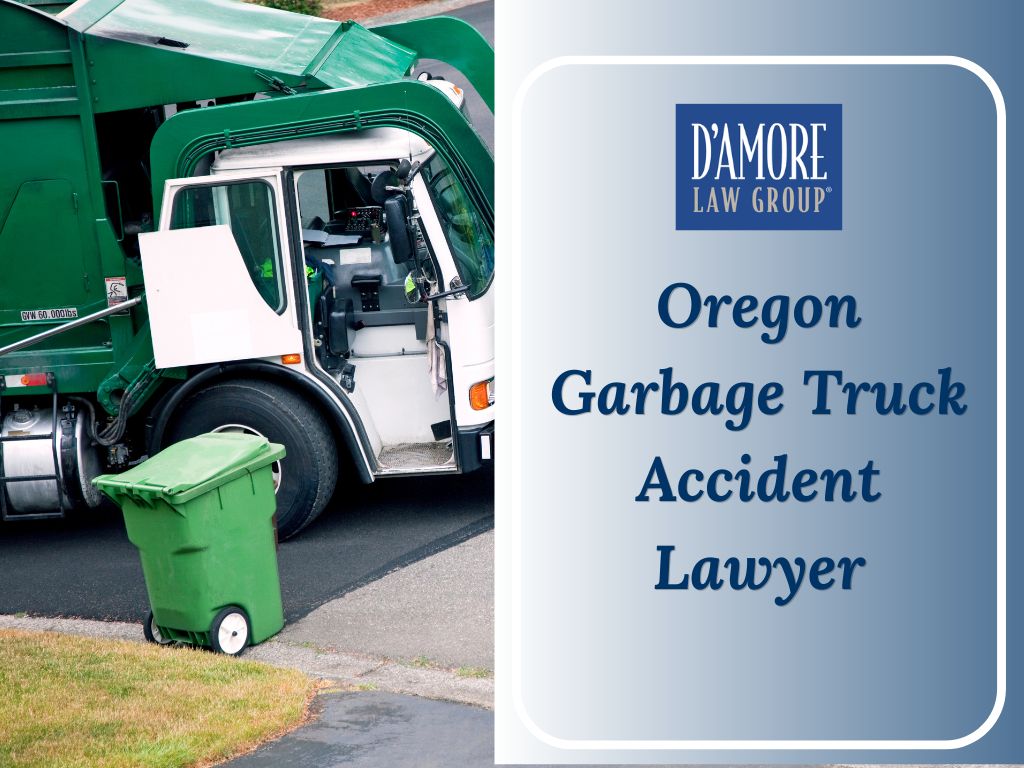
A sanitation truck stops ahead of you, then suddenly reverses. A collection vehicle swings wide into a bicycle lane. A heavy truck leaves a driveway while its operator watches the loading mechanism instead of traffic.
These crashes do not feel like ordinary collisions, and the claims rarely are. An experienced garbage truck accident lawyer can determine whether the truck belonged to a city, county, private waste company, or contractor and take the right steps before critical deadlines or evidence disappear.
Contact us today at 503-222-6333 to discuss your case and learn how we can help you.
The immediate questions are practical: Can a city be held accountable? Where are the truck’s camera footage and route records? D’Amore Law Group investigates while clients focus on recovery.
Key Takeaways
- Ownership of the truck changes the legal path. A garbage truck may belong to a city, county, private waste company, or contractor, and a Recology or Waste Management logo does not prove who operated it, so the operator, employer, owner, and maintenance provider must all be identified.
- Claims against a city or county are generally governed by the Oregon Tort Claims Act. Public bodies can be sued for their torts and for those of employees acting within the scope of their duties, but you must still prove negligence, causation, and damages.
- Most personal injury claims against a public body require formal notice within 180 days of the injury. This is separate from the two-year period for filing a lawsuit, and missing the earlier notice requirement can destroy a valid claim (wrongful-death claims generally have a one-year notice period).
- Onboard video, GPS data, dispatch communications, inspection files, and training records can be overwritten under routine retention policies. A prompt preservation demand helps protect the evidence that shows where the truck stopped, whether it reversed, and what the driver could see.
- Unsafe backing, inadequate spotters, distracted driving, poor maintenance, speeding, and failure to yield are common causes. Even a low-speed maneuver can cause severe or fatal injuries to a pedestrian or cyclist because of the truck’s large blind areas.
- Public-entity cases may involve a statutory damages cap that is adjusted annually. Private-company cases follow different rules and can include claims for negligent hiring, training, supervision, or maintenance, so a lawyer should confirm which limits apply on the crash date.
Why Garbage Truck Crashes Cause Devastating Injuries
Garbage and recycling trucks are large, heavy vehicles that repeatedly stop, reverse, turn, and operate close to homes, sidewalks, bicycle lanes, and parked cars. Their shape creates substantial blind areas. A driver may lose sight of a person behind the truck, while the vehicle’s rear-swing blind spot can endanger someone beside it as the truck turns.
Common causes include unsafe backing, inadequate spotters, distracted driving, poor maintenance, excessive speed, and failure to yield. A collision may seriously injure a motorist, sanitation worker, pedestrian, or cyclist. A pedestrian or cyclist may suffer severe or even fatal injuries even from a low-speed maneuver.
Ownership changes the legal path. A city vehicle may trigger public-entity rules. A truck bearing the name Recology or Waste Management may be operated by a subsidiary or contractor. An investigation must identify the operator, employer, owner, and maintenance provider.
When You Need an Oregon Garbage Truck Accident Lawyer
The first days matter. Public agencies and waste companies may possess onboard video, GPS information, dispatch communications, inspection files, employee training records, and sanitation route records. These materials can establish where the truck stopped, whether it reversed, what the driver could see, and whether similar safety concerns had been reported. A prompt preservation demand can help prevent relevant electronic information from being overwritten under routine retention policies.
An attorney can obtain reports, interview witnesses, inspect the truck, retain appropriate experts, and identify insurance. D’Amore Law Group’s Oregon truck accident attorney resources explain why fast evidence preservation and a complete search for responsible parties are essential.
Government Ownership Changes the Claim Process
If a City of Portland vehicle or another municipal truck caused the crash, the claim may fall under the Oregon Tort Claims Act. The same may be true of a vehicle in a Multnomah County fleet. Oregon law provides a limited municipal immunity waiver: Public bodies may be sued for their torts and for torts committed by employees acting within the scope of their duties, subject to statutory restrictions.
That framework, sometimes described as Oregon Government Tort Liability, does not guarantee payment. The injured person must prove negligence, causation, and damages. The agency may dispute fault, employment scope, or legally sufficient notice.
A City of Portland liability claim may require identifying the correct bureau and claims administrator. Local bodies may buy coverage or self-insure, so public entity insurance may influence investigation and settlement.
Why Oregon Garbage Truck Accident Victims Choose D’Amore Law Group
- Decades of Truck Case Experience, Over 2,000 Cases Handled: D’Amore Law Group has represented injured people in complex truck cases for decades, combining careful preparation, experienced advocacy, and personal attention.
- Oregon’s Highest Trucking Verdict: D’Amore Law Group secured a $26.5M jury verdict in a semi-truck case involving wrongful death and catastrophic injuries, and has recovered $22M and $3.99M in other fatal semi-truck cases.
- We Identify Every Responsible Party: Is the truck owned by a city, county, private waste company, or contractor? We examine contracts, employment relationships, and corporate structures instead of relying on the logo on the truck.
- We Move Fast to Preserve Evidence: Onboard video, GPS information, dispatch communications, inspection files, and training records can be overwritten under routine retention policies. We send preservation demands early to help protect them.
- Experience with Government Claims and the 180-Day Notice Rule: We handle claims involving city and county vehicles under the Oregon Tort Claims Act, including identifying the correct agency and delivering formal notice to the right recipient before critical deadlines pass.
- Full-Service Representation, You Focus on Recovery: We obtain reports, interview witnesses, inspect the truck, retain appropriate experts, identify insurance, document your losses, negotiate, and prepare for trial.
- Five Locations in Oregon and Washington: Our offices in Portland, Bend, Lake Oswego, Vancouver, and Tacoma make it easier to meet with a team that understands your community.
- No Fee Unless We Win: Your consultation is free, and you pay nothing unless D’Amore Law Group recovers compensation for you.
The Notice of Claim and 180-Day Rule
Oregon law generally requires notice of a non–wrongful-death tort claim against a public body within 180 days after the alleged loss or injury. This notice of claim (180-day rule) is not merely the ordinary deadline for filing a lawsuit. It is an additional procedural requirement, and the claimant bears the burden of proving compliance.
Formal notice states that a damages claim will be asserted, describes the known time, place, and circumstances, and provides the claimant’s name and address. It must reach an authorized recipient. An accident report or conversation with the driver may not be enough.
The same statute generally provides a separate two-year period for commencing an Oregon Tort Claims Act action, subject to exceptions. Waiting for that broader period can destroy a valid claim if the earlier notice requirement is missed.
Compensation and Public-Entity Limits
A claim may seek medical expenses, lost income, rehabilitation costs, property loss, and compensation for pain and reduced quality of life. Fatal crashes may support a wrongful-death claim.
Government cases may also involve a statutory personal injury damages cap. The applicable amount depends on whether the defendant is a state or local public body, how many claimants are involved, when the claim arose, and other legal issues. Oregon’s courts publish current Oregon Tort Claims Act liability limits, which are adjusted annually. A lawyer should evaluate the limit applicable on the crash date rather than assume that a number from an older source controls.
Private-company cases follow different rules. An employer may answer for a driver’s negligent operation within the scope of employment. Negligent hiring, training, supervision, maintenance, or safety policies may also create liability. A garbage truck accident attorney examines contracts and corporate relationships instead of relying on the truck’s logo.
How D’Amore Law Group Can Help
D’Amore Law Group has represented injured people in complex truck cases for decades and handled more than 2,000 cases. Its approach combines careful preparation, experienced advocacy, and personal attention.
Your legal team can identify defendants, deliver notices, preserve truck data, document losses, negotiate, and prepare for trial. If a sanitation vehicle injured you or someone you love, speak with a garbage truck accident lawyer promptly. D’Amore Law Group offers a free consultation, and there is no fee unless the firm wins.
Frequently Asked Questions
Can I Sue a City or County in Oregon If a Government Garbage Truck Injured Me?
Potentially, yes. The law generally subjects public bodies to civil actions for their torts and those of employees acting within the scope of their duties. The claim must still satisfy the Oregon Tort Claims Act’s notice, proof, timing, and liability requirements.
What Is the Oregon Tort Claims Act and How Does It Limit Claims Against Public Entities?
It is the statutory framework governing many tort claims against Oregon state and local public bodies. It permits covered claims while imposing special notice procedures, rules about the proper defendant, defenses, and annually adjusted liability limits.
How Quickly Must I File a Notice of Claim Against a Government Entity in Oregon?
For most personal-injury claims, Oregon law generally requires notice within 180 days after the alleged loss or injury. Wrongful-death claims generally have a one-year notice period, and limited rules can affect the calculation. Because the recipient and content matter, contact counsel immediately rather than waiting near the deadline.
Who Is Liable When a Private Waste Company’s Truck Causes an Accident in Oregon?
Depending on the evidence, responsible parties may include the driver, employer, truck owner, maintenance contractor, another subcontractor, or equipment manufacturer. Companies such as Recology or Waste Management may operate through local entities or contractual arrangements, so ownership, employment, and service contracts must be verified.
Legal References Used to Inform This Page
To ensure the accuracy and clarity of this page, we referenced official legal resources during the content development process.
