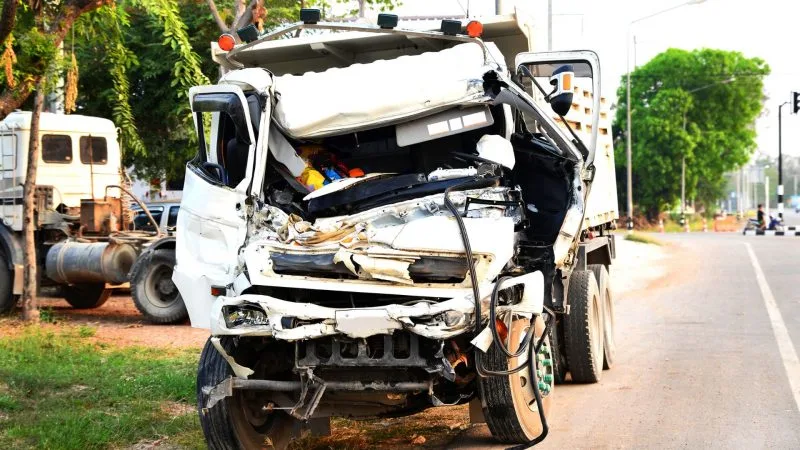
If you or your loved one has been in a truck accident, we know these are challenging times for you. You may be entitled to compensation. To recover compensation, you must prove that the accident was the fault of another party. You can prove fault under the law of truck accident negligence.
When people ask, “What is negligence in truck accidents?” They are really asking how the law determines liability after a serious crash involving a commercial vehicle. In these cases, negligence refers to a failure to act with reasonable care under the circumstances. Because commercial trucks are large, complex, and heavily regulated, even a minor mistake can have devastating consequences. Understanding what constitutes negligence in truck accidents is essential for anyone pursuing a personal injury claim.
Negligence is established by proving four elements: duty, breach, causation, and damages. It can be hard to establish negligence, especially if multiple parties are involved in the truck accident. A board-certified truck accident lawyer can help explain how negligence is established in a truck accident. It is best to hire a board-certified truck accident attorney with experience to build your negligence case and get you the compensation you deserve.
Contact us today at 503-222-6333 to discuss your case and learn how we can help you.
Elements Required to Establish Negligence
Negligence is a breach of a duty of care that causes harm. A truck accident claim is based on the law of negligence. You must prove the four elements to successfully make a negligence claim.
These four elements are sometimes referred to as the “elements of a negligent driver claim,” and they form the legal foundation for nearly all personal injury cases involving commercial vehicles. Courts in both Oregon and Washington apply these same principles when evaluating negligence claims arising from truck accidents.
Duty
For any negligence claim, the plaintiff must show that the defendant owed the plaintiff a duty of care. This duty of care refers to ordinary care that a reasonable person would exercise in a similar situation. In the context of driving, this element is generally simple to prove. Every driver on the road has the duty to drive safely and competently to protect other drivers, cyclists, and pedestrians. Therefore, a truck driver owes a duty of care to drive safely.
In the trucking industry, this duty is even more important due to the risks associated with large commercial vehicles. Federal regulations enforced by the Federal Motor Carrier Safety Administration establish strict safety standards. These rules govern driver behavior, vehicle maintenance, and cargo handling. Violating these standards can be strong evidence that a driver or company failed to meet their duty of care.
Let’s Get in Touch Today!
D’Amore Law Group has four convenient locations in Oregon and Washington.
Breach
The next element you must prove is a breach of duty. The defendant must do something to violate the duty they owed. For example, if a truck driver ran a red light or drove while under the influence of alcohol, they breached their duty to drive safely on the road.
Examples include running a red light, driving under the influence, or violating hours-of-service regulations, which limit how long a truck driver can operate without rest. Fatigue is one of the leading causes of commercial truck accidents, and driving beyond legal limits can clearly establish a breach of duty. Other breaches may include negligent maintenance, failing to inspect brakes, or ignoring known mechanical issues.
Causation
The third element of negligence is causation. You must show a direct causal relationship between the breach of duty and the accident and injuries suffered. It is not enough that the truck driver breached their duty to drive safely by driving under the influence of alcohol. You must show that it was the truck driver’s impairment from alcohol that caused your accident and injuries.
In many cases, causation is established through expert testimony, including accident reconstruction specialists. These professionals analyze skid marks, vehicle damage, electronic logging devices, and roadway conditions to determine exactly how the crash occurred. Their findings can be critical when proving negligence in trucking accidents involving commercial drivers.
Damages
The last element to prove is damages. You must have suffered some damage from the negligent act. This can include physical, emotional, and psychological injuries. Loss of income and property damage are also examples of damages.
Damages in truck accident cases are often substantial due to the severity of collisions involving large trucks. Victims may face long-term medical care, rehabilitation, and loss of earning capacity. According to data from the National Safety Council, thousands of fatalities and serious injuries occur each year in crashes involving large trucks, highlighting the serious consequences of commercial truck driver negligence.
Possible Negligent Parties
In many truck accident cases, more than one party may share responsibility for the crash. In these situations, determining liability requires careful analysis of each party’s actions and their contributions to the accident.
Truck Driver
Truck driver negligence is the failure to drive a commercial vehicle with reasonable care. It includes distracted, fatigued, impaired, or aggressive driving, speeding, or poor truck maintenance.
Common examples include:
- Driving while fatigued,
- Failing to follow traffic laws,
- Failing to brake,
- Driving under the influence, and
- Driving while distracted.
These actions may constitute a breach of the driver’s duty of care and can establish liability when they contribute to a crash.
Additional examples of truck driver negligence include improper lane changes, failure to check blind spots, and failure to account for weather conditions. These actions generally fall squarely within negligence and are often central when determining negligence in trucking accident claims.
Truck Company
If the truck driver is an employee, then the truck company can be vicariously liable for its employee’s actions. Truck companies can also have the following duties:
- Duty to hire drivers who know how to drive a truck;
- Duty to provide sufficient job training for the drivers;
- Duty to ensure truck weight does not exceed its max load;
- Duty to perform background checks on employees to ensure that they do not have a bad driving history; and
- Duty to ensure that trucks receive regularly scheduled maintenance.
This concept is often referred to as trucking company liability. In addition to vicarious liability, companies may be directly responsible for negligent hiring, inadequate supervision, or unsafe company policies that prioritize delivery speed over safety.
Truck Manufacturing Companies
An error or problem in the manufacturing process can cause a truck accident. Manufacturers of trucks and truck parts have a duty to build products that are safe. If the design or manufacturing process is unsafe or defective, then the responsible parties can be held liable for resulting injuries. These are usually strict liability claims, which means you do not have to prove negligence; you just need to prove that the product was unsafe and caused injury.
Cargo Loader
A cargo loader has a duty to ensure that a truck’s cargo is secured and properly loaded into the truck. For example, suppose a cargo of logs is improperly tied onto the truck, so the logs fall into oncoming traffic. The cargo loader is liable for injuries caused by the falling logs. The cargo loader breached its duty when it did not properly secure the logs on the truck.
Improper loading practices are often referred to as cargo loading violations. Shifting cargo can destabilize a truck, increasing the risk of rollovers or jackknife accidents. These violations are also regulated under federal safety standards.
Truck Maintenance Company
Trucks must be maintained regularly to ensure there are no issues and that the truck can run effectively and safely. Examples include the following:
- There are no fuel leaks;
- There are no brake issues;
- The engine runs smoothly; and
- The tire pressure is sufficient.
If the truck maintenance company fails to detect a problem it reasonably should have caught during scheduled maintenance, then it has breached its duty. If this defect or problem caused your injuries in the accident, then the truck maintenance company can be liable for negligence.
Failure to conduct routine inspections can lead to negligent maintenance claims. Brake failures, worn tires, and engine defects are common causes of serious trucking accidents.
Government
Governments can also be liable for a truck accident. Generally, a city or local government must maintain its roads, infrastructure, and traffic signs. Federal and state governments may also have these duties and maintain federal and state highways. If anything has a defect, then the government may be liable. For example, suppose a city government is responsible for ensuring traffic lights are in working order, but a traffic light is broken down. If a truck runs the light and causes injuries, the government can be liable because it breached its duty to maintain the traffic lights.
Keep in mind, however, that claims against the government can involve special rules, and the government is immune from liability on certain claims. It’s important to consult with certified truck accident attorneys to understand how to bring a claim against a government entity.
How Is Fault Determined?
Not every state has the same negligence laws. D’Amore Law Group has offices in Washington State and Oregon. While proving the four elements of negligence are basically the same from state to state, determining fault and compensation can be different.
How fault is determined and divided can directly affect your ability to recover compensation. Even if you are partially at fault, you may still be entitled to damages depending on the laws in your state. An attorney can help ensure that fault is fairly assessed and that insurance companies do not attempt to shift an unfair portion of the blame onto you.
In both Washington and Oregon, courts apply some form of comparative negligence, meaning fault can be shared among multiple parties. This makes determining negligence in trucking accident cases more complex, especially when multiple drivers or companies contribute to the crash.
Washington
The State of Washington is a pure comparative fault state. This means both parties can be responsible for the accident. However, that does not bar recovery. Under pure comparative negligence, you cannot recover damages for the portion of the accident you were responsible for.
For example, suppose you were speeding, and a truck ran a red light because the driver was on their cell phone. You were found to be 20% at fault for the accident, and the truck driver was 80% at fault. You suffered $200,000 in damages. You can recover only 80% of the damages ($160,000). You cannot recover the other 20% of the damages ($40,000) because you were at fault.
Oregon
Oregon is a modified comparative negligence state. This is different from Washington’s pure comparative negligence. Under modified comparative negligence, you cannot recover damages at all if your share of fault is more than 50%. If you are 50% or more at fault, your damages will be reduced by the percentage you are at fault.
For example, suppose you ran a red light, and the truck driver was under the influence of alcohol. You were found to be 40% at fault, and the truck driver is 60% at fault. The damages are $100,000. You can only recover 60% of the damages ($60,000). You cannot recover the other 40% of the damages ($40,000) because you were at fault.
Alternatively, if you were 60% at fault and the truck driver was 40% at fault, you cannot recover any damages because your fault is greater than the truck driver’s fault.
How Long Do I Have to Bring a Truck Accident Negligence Claim?
The time you have to bring any claim is called the statute of limitations. Every claim has a statute of limitations, though the time limit varies based on the type of claim and the jurisdiction. Once the statute of limitations expires, you will be barred from pursuing the claim. A court will dismiss your case if you attempt to file a claim past the deadline.
The reason the statute of limitations exists is to ensure cases that are litigated are recent. As time passes, memories fade, and evidence is lost. It is unfair to litigate a case after an extended period of time has passed.
It is important to note that these deadlines are governed by state statutes. Truck accident claims fall under personal injury law. Washington and Oregon have their setown statute of limitations for personal injury.
- In Washington, a plaintiff has three years to bring a personal injury claim.
- In Oregon, a plaintiff has two years to bring a personal injury claim.
Contact a board-certified truck accident attorney to ensure you do not miss your deadline to recover compensation. Missing these deadlines can permanently bar your claim, regardless of its merits, so it is in your best interest to act quickly.
The Importance of Guidance on Proving Negligence
Building a strong truck accident claim is not just about showing that something went wrong. It is about clearly connecting the evidence to legal responsibility. Proving negligence in trucking accidents involving commercial drivers often requires a detailed investigation that includes driver logs, black box data, maintenance records, inspection reports, and witness statements. Without a strategic approach, critical evidence can be missed or misinterpreted.
An experienced attorney plays a key role in organizing and analyzing this information to establish liability. This is especially important in cases involving multiple parties, where determining who is responsible is not always straightforward. Lawyers often work with industry experts, including accident reconstruction specialists, to piece together exactly how the crash occurred and who should be held accountable.
Many victims also ask: Can a lawyer help prove negligence in fatal truck accident cases? The answer is yes. An experienced attorney can coordinate experts, preserve evidence, and build a compelling case that clearly demonstrates liability.
For guidance specific to your situation, contact a Portland truck accident lawyer at D’Amore Law Group.
Oregon Semi-Truck Accident Statute of Limitations Calculator
Enter the date of your accident to see the filing deadline that generally applies to your situation under Oregon law.
Disclaimer: This calculator provides general deadline estimates only and is not legal advice. Semi-truck accident claims often involve federal regulatory evidence (ELD data, driver qualification files, maintenance logs) that carriers can overwrite or destroy within days, separate from the legal filing deadline shown here. Some deadlines may run from treatment dates, work-loss dates, the date of death, notice-filing dates, claim denial dates, or other case-specific events rather than the accident date alone. Government claims carry additional notice requirements that can be much shorter than the filing deadline itself. This calculator applies to Oregon cases only; Washington injury claims generally carry a three-year deadline instead (RCW 4.16.080). Always verify deadlines with a licensed Oregon attorney.
FAQs
Who Can Be Held Liable for Negligence in a Trucking Accident?
Multiple parties may be liable, including the truck driver, trucking company, cargo loaders, maintenance providers, and even manufacturers. Liability depends on who breached their duty and caused the accident.
What Are Common Examples of Truck Driver Negligence?
Common examples include speeding, distracted driving, fatigue, impaired driving, and failing to follow safety regulations. These behaviors are key indicators of truck driver negligence.
Can a Trucking Company Be Responsible for a Driver’s Negligence?
Yes. Under trucking company liability principles, employers can be held responsible for their drivers’ actions and for their own negligent hiring, training, or supervision practices.
How do Hours-of-Service Violations Contribute to Truck Accident Negligence?
Violating hours-of-service regulations can lead to driver fatigue, which significantly increases the risk of accidents. These violations are often used as evidence of negligence.
What Evidence is Used to Prove Negligence in Truck Accident Claims?
Evidence may include black box data, driver logs, maintenance records, police reports, and expert analysis such as accident reconstruction.
How Does Comparative Negligence Affect Truck Accident Compensation?
Comparative negligence reduces your compensation based on your percentage of fault. The rules vary from state to state, like Oregon and Washington.
What Role Does the FMCSA Play in Truck Accident Negligence Cases?
The FMCSA sets safety standards for the trucking industry. Violations of these regulations can serve as strong evidence of negligence in a truck accident claim.
What Does Negligence Mean in a Truck Accident Case?
Negligence in a truck accident means the driver or company failed to use reasonable care, causing a crash. Proving it requires showing a legal duty, a breach, and resulting harm.
Is Driver Error Always Required to Prove Negligence in a Truck Accident?
Negligence doesn’t always require driver error. It can also involve faulty truck parts, poor cargo loading, or unsafe company policies that raise crash risk.
Contact D’Amore Law Group
You don’t have to face the aftermath of a truck accident alone. Our experienced legal team at D’Amore Law Group will stand by your side. We will help gather the evidence, negotiate with ruthless insurance companies, and represent you at trial if necessary. Money can’t reverse the damage done or heal your injuries. But it can help lessen the financial nightmare you and your family have been in since the accident.
D’Amore Law Group has been a pillar of the community for over three decades, and Tom D’Amore is one of the few attorneys in the Pacific Northwest to receive a truck accident law certification through the National Board of Trial Advocacy. Contact us now for a free case evaluation. We get no fee unless we win, so don’t wait.
Legal References Used to Inform This Page
To ensure the accuracy and clarity of this page, we referenced official legal resources during the content development process:
About the Author
Tom D'Amore is the founder of D'Amore Law Group and a trial attorney with over 30 years of experience representing injured people and their families across the West Coast, securing more than $325 million in recoveries. He handles cases involving
car accidents,
trucking accidents,
construction injuries,
medical malpractice, and
sexual abuse. Licensed in Oregon, Washington, and California, Tom is the only NBTA board-certified truck accident attorney in Oregon. He is a national Board of Governors member, past Executive Committee member, and past Budget and Audit Chair of the American Association for Justice, as well as past President of the Oregon Trial Lawyers Association and an Eagle member of the Washington State Association for Justice.